
Historic day for Solana: new, faster consensus is now live on mainnet
On Wednesday, 21 October 2026, Solana mainnet-beta moved from TowerBFT consensus to Alpenglow. TowerBFT is how validators have agreed on blocks since the network launched, and it is history now. A block can be final in about 150 milliseconds. A slot lasts 200 milliseconds.
Epoch 1064 began at slot 459,648,000, and the network's own timestamp places that slot at 13:36:05 UTC. The feature gate turned on there. Consensus did not change at that moment. Anza marked the next stretch "Migration in progress," with about 17 minutes on the timer: 5,000 slots of TowerBFT. In the event, they took 17 minutes and 55 seconds. The Alpenglow genesis certificate covered slot 459,652,999 at 13:54:00 UTC. Anza had named slot 459,653,000 as the migration boundary: one slot, and TowerBFT is out. That slot and the seven after it are not on the ledger. The next block is slot 459,653,008, at 13:54:03 UTC. Anza confirmed the switch a few minutes later. Eighteen months of work, and a migration built to finish inside a single slot. Finality, the moment a block can no longer be undone, is aimed at about 150 milliseconds.
The slot does not move. Since epoch 1053, on 9 October, a slot lasts 200 milliseconds: that is the leader's turn. A block is what the leader produces during that turn. Alpenglow pulls a different lever: how long the network waits before that block becomes irreversible. How this upgrade looked in July, and how public testnet worked through the switch in September, is in the July note and the Alpenswitch piece.
What actually changes
Alpenglow replaces TowerBFT, the way Solana's validators have agreed on blocks since the network launched. SIMD-0326 is that consensus. The voting protocol inside it is called Votor.
Under TowerBFT a validator voted with a transaction, and those votes were packed into the blocks. Votor takes the votes off the ledger. They become direct messages between validators, each signed so they can be gathered into one certificate. A block becomes final after one or two of those rounds, not after a long stack of confirmations.
Votor runs two races at once. If the validators holding 80% of the network's total stake respond in a single round, that race closes the block. If the answers come in more slowly, a second round can close it at 60% of that same stake. Whichever race finishes first is the result, and Anza puts that at about 150 milliseconds.
Proof of History no longer sets the pace of block production. Each node keeps its own timer now. If a leader goes quiet, the others vote to skip it, a skip certificate forms, and the chain moves on. The slot remains. What disappears is the steady tick that used to mark time inside it.
Votes used to take up a large share of the transactions in a block. They now free that room for user transactions. A board that counted votes will show a sharp drop. That drop is the missing votes, not a quieter network. The SVM, transaction formats, and fees do not change with this switch. Rotor, a later change to how a block's data spreads across the network, is not part of this activation.
What can go wrong changes too. TowerBFT was built to neutralize the influence of validators who behave dishonestly. Alpenglow is built so the network keeps working even when 20% of the network's stake is actively attacking it and another 20% is simply offline.
In plain terms
A validator's yes used to be written into the following blocks, and the network waited seconds for enough of those blocks to pile up. Validators now say yes directly to one another, so it never lands in a block.
A payment becomes final in about 150 milliseconds once the yeses reach about 80% of the network's total stake (what counts is the SOL delegated to them, not the number of validators), or 60% of that same stake if a second round is needed. The leader's turn, the slot, still lasts 200 milliseconds, and a block is simply what the leader produces during that turn.
Two indicators, and the old numbers
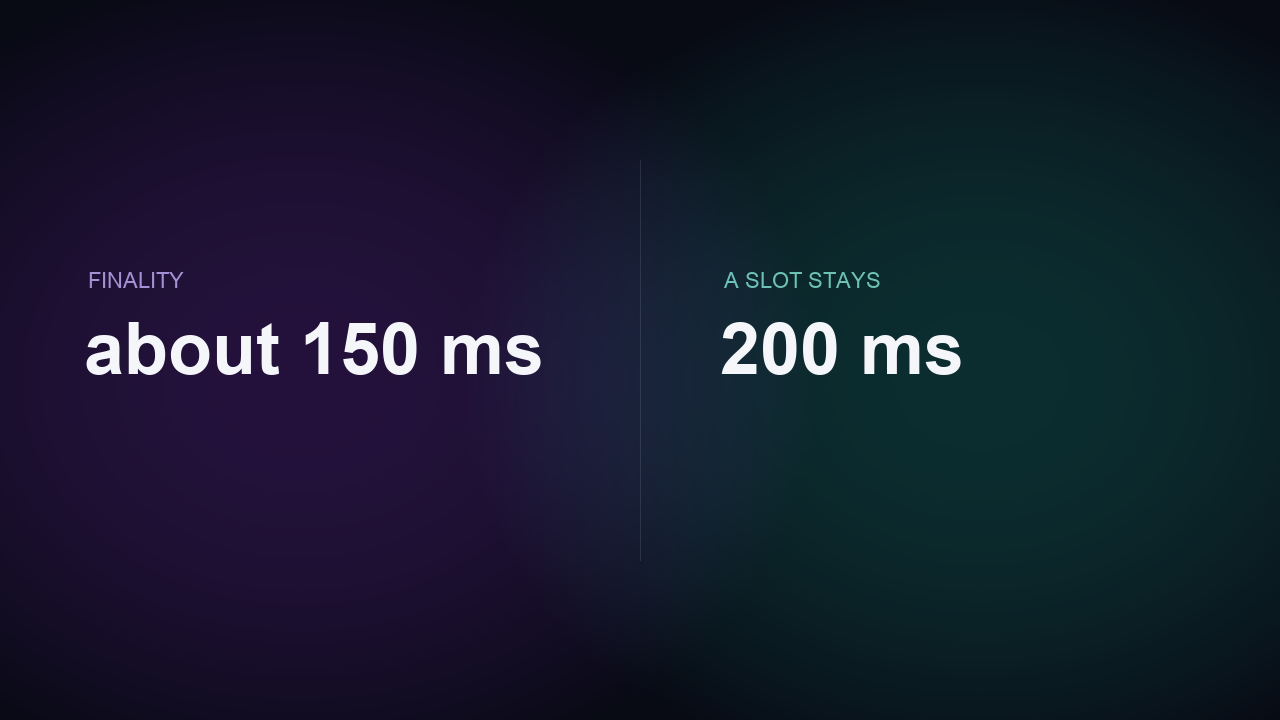
This is the place where it is easy to get it wrong. There are two different indicators. 150 milliseconds is finality: how long you wait before a payment can no longer be undone. 200 milliseconds is the slot, the leader's turn; a block is what the leader produces during that turn. Shortening the slot, which happened on 9 October, changed only the second figure. Alpenglow changes the first: finality becomes about 150ms, and the slot still lasts 200ms.
The other number that is easy to misread is 12.8 seconds. That is TowerBFT finality, calculated from the original 400ms slot (32 slots at 400ms). On today's 200ms clock, that same stack of 32 slots is about 6.4 seconds. Anza's message puts the change this way: finality falls from 12.8 seconds to 150 milliseconds. Both 12.8 and 6.4 are how long people used to wait for TowerBFT finality, not how long a 200-millisecond slot lasts.
confirmed and finalized are the same thing now: Votor is already running
on mainnet-beta.
What this means for…
Validators
The gate required v4.3.2: Agave, Jito-Solana, or Harmonic Salsa. Anza announced that release on 16 October. Firedancer and Frankendancer were not part of this migration. An operator who stayed on either one was outside the switch.
The per-slot vote transaction goes away. In its place the Validator Admission Ticket takes 0.8 SOL per epoch from the vote account and burns it. On top of that ticket, the account still has to hold its rent-exempt minimum. The July note carried an earlier proposal of 1.6 SOL. The identity account paid for votes under TowerBFT. It does not pay this ticket. If the vote account cannot cover the charge, the validator produces no blocks the next epoch.
Keep 0.8 SOL plus the rent-exempt minimum on the vote account every epoch (the balance there often comes to about 0.83 SOL). The first charge is taken at the start of epoch 1064, and it pays for epoch 1065.
Delegators
If you stake natively, there is nothing you need to do, unless you have already noticed trouble with your validator. If the operator misses the client change or drains the vote account, that validator cannot produce blocks or earn block rewards for those slots in the next epoch, and that cuts into what your stake earns.
Builders
A substantial increase in speed opens new possibilities. For founders coming from Web2, Solana is a more attractive place to build. What you cannot mix up is the two figures. A confirmation screen can treat finality as about 150ms. The slot stays 200ms: do not record 150ms as the new block time. Fees, the SVM, and transaction formats do not change. Vote transactions leave the blocks, so a TPS chart that included them falls even though user traffic did not.
Everyday users
If you hold or send SOL, there is nothing to set up. A transfer can become irreversible in about 150 milliseconds, rather than several seconds. Fees stay the same.
Sources: Anza – Alpenglow is live on mainnet-beta, 21 October 2026 · Anza – Migration in progress, 21 October 2026 · Anza – migration boundary, slot 459,653,000, ~14:00 UTC, 20 October 2026 · Anza – epoch 1064 tracking earlier, 19 October 2026 · Anza – Agave v4.3.2, 16 October 2026 · Anza – first mark, ~14:50 UTC, 13 October 2026 · Anza – Alpenglow · Solana – Alpenglow · SIMD-0326 · SIMD-0384