
Solana's clock just sped up: 250ms slots are live on mainnet
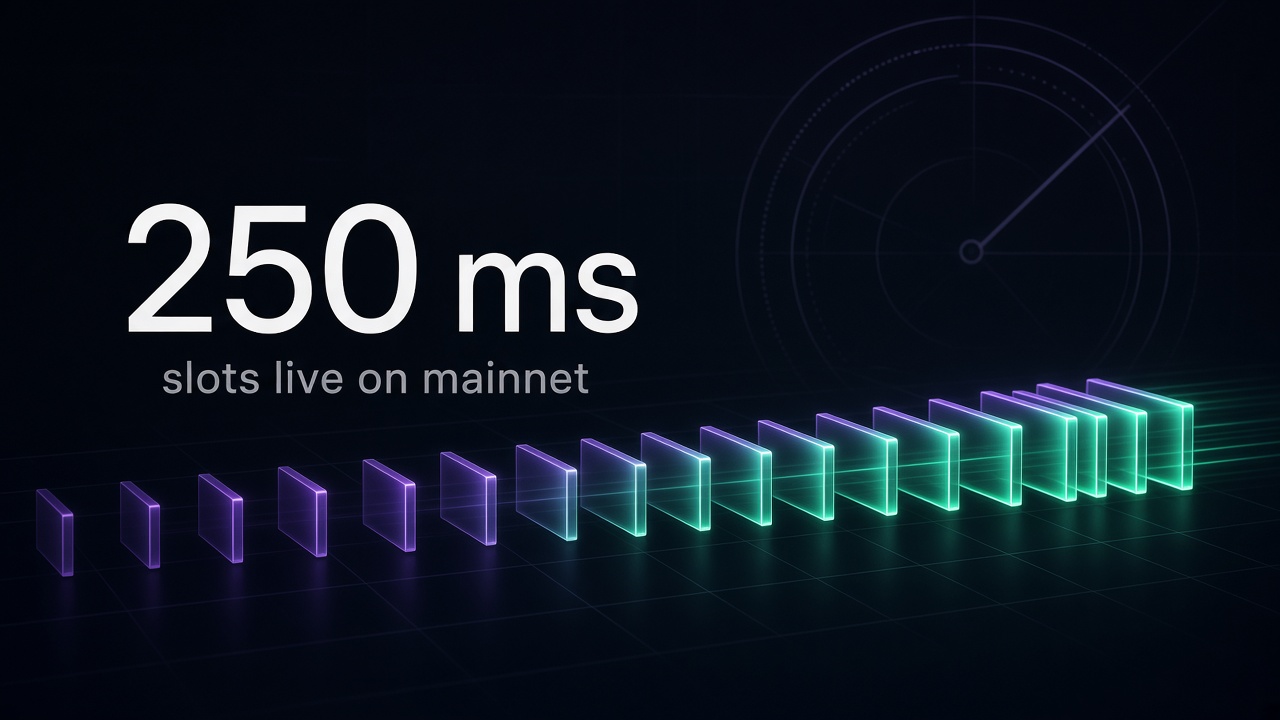
On September 18, 2026, Solana mainnet crossed into epoch 1037 and started producing blocks on a 250-millisecond clock. Anza confirmed the activation. This is the third 50ms cut under SIMD-0525, the slot-time roadmap Agave 4.2 shipped behind feature gates. One step remains – 200ms – and it has no mainnet date yet.
What a slot actually is
A slot is the short window in which a designated validator – the leader – may add a block. Solana still gives that leader four consecutive slots. At 400ms, that window lasted 1.6 seconds. At 250ms it lasts one second. Users see a fresher chain. A single leader also has less wall-clock time to delay, reorder, or selectively include transactions before the next leader takes over.
The network originally targeted 400ms. Feature gates then stepped it down:
- 350ms – August 19, start of epoch 1019
- 300ms – August 25, start of epoch 1023
- 250ms – September 18, start of epoch 1037
- 200ms – live on devnet and testnet; mainnet only if skip rates stay acceptable
Each gate becomes active at one epoch boundary and only starts governing block production at the next. That lag lets Turbine and shred filters pick up the new per-slot limits before leaders have to meet them.
Faster clock, same workload ceiling
This is the part that is easy to get wrong. The network now targets four slots a second, up from about 3.3 at 300ms. That is not more transactions per second. Under SIMD-0525, the compute and data allowed in each slot shrink by the same proportion as the slot itself. At 250ms, the max block compute budget is 37.5 million CUs, down from 60 million at 400ms – so the per-second budget stays about where it was.
That wait is latency. Wallets, DEX UIs, and market makers see state sooner.
Any confirmation or finality threshold that is counted in slots takes less
real time. Epochs are still a fixed 432,000 slots, but they now last about
30 hours instead of 48 hours at 400ms (and 36 hours at 300ms). Stake rewards
show up more often because epochs are shorter. They are not larger over a year:
SIMD-0525 raises slots_per_year so annual inflation stays the same.
A recent blockhash is still valid for 150 slots. At a 250ms clock that is about 38 seconds of real time, down from about 60 seconds at the original 400ms target. Offline signing, and any flow that waits for someone to click approve, has less slack.
What it means for…
Validators
Watch skip rates. That is the metric that decides whether 200ms gets a mainnet date. Leader windows are one second; replay, voting, and block packing have less real time than they did at 400ms. Shorter epochs mean reward cycles and operator tasks come around faster. The 250ms switch itself was a feature gate already in Agave 4.2, not a new binary on the day – but operators on stale clients still show up in skip stats.
Delegators
No restaking, no wallet migration. The practical signal is still operator discipline: prefer validators who publish their client version and keep skip rates down as the clock tightens. Faster slots improve the apps you use. They do not, by themselves, raise the network's transaction ceiling, and they do not increase annual inflation.
Builders
Do not hardcode a slot duration when you convert slots to time. Use
getBlockTime or the current slot duration. Blockhash expiry is tighter, so
retry logic and signing that waits on a person need to assume less wait.
Indexers do not need a new format, but they ingest more blocks per day than at
the original 400ms clock. Design UX for snappier updates – not for a hidden
throughput bump that is not there.
Everyone else
If you hold or send SOL, the change is mostly something you feel: transfers and swaps should confirm a bit sooner, and apps should look less "one beat behind." You do not configure anything. The 200ms step is still unscheduled. It proceeds only if 250ms holds up under real traffic.
Same week, related upgrades
Two other Agave 4.2 upgrades landed the same week. Transaction v1 activated at epoch 1035 on September 15, raising max transaction size from 1,232 to 4,096 bytes. Agave 4.3 reached mainnet on September 18 with the full Alpenglow codebase still feature-gated off. That consensus flip is expected around a later 4.4 release, not in 4.3.
Sources: SIMD-0525 · Solana Foundation – Reduced slot times · CoinDesk – 250ms slots, same capacity